

How do we heat our houses? - THE MAIN RESULTS OF THE STATISTICAL RESEARCH INVOLVING SINGLE-FAMILY HOUSES IN POLAND


The research was carried out in December 2020. The results can be compared with similar research carried out in 2013 by the Institute of Environmental Economics . Therefore, we can observe what has changed over the last seven years in terms of used heating sources or the energy efficiency of buildings.
Heating sources
One of the most important pieces of information provided by the research is the fact that fewer and fewer people living in Poland use coal to heat them (compared to 2014, the percentage of such households fell from 69% to 51%) and this is by far the biggest change when it comes to heating sources. However, it should be remembered that still more than half of the houses are heated with coal. At the same time, the number of gas-heated households increased from 14% to 24%. The percentage of houses heated with biomass also increased, from 14% to 19%. The comparison of the structure of heating sources in 2014 and 2020 is presented in the chart below.


 The obtained data regarding the type and age of heating devices were the basis to identify a group of devices that do not meet the requirements of anti-smog resolutions and as such qualify for replacement in the coming years – hereinafter called the ‘target group’. As many as 54% of single-family houses in Poland are heated with coal and wood boilers that emit too much pollution and do not meet the emission limits set out in anti-smog resolutions. This is almost 3 million boilers on a national scale, which should be replaced in the coming years. Most of these devices are found in older houses and in rural areas.

Plans for the modernisation of sources for solid fuels
Among the results in the field of modernisation of heating sources, the fact that almost half of the respondents whose houses are heated with boilers that do not meet the requirements of anti-smog resolutions do not have any plans to change the heating source is the most significant. This information should alarm central, regional and local authorities. An intensive information campaign regarding the requirements of anti-smog resolutions, and at the same time promoting the available subsidy programs, is needed to eliminate obsolete heat sources.
Gaseous fuel is the most frequently chosen among people who are planning such a change. Less than 9% of the respondents from the target group decided to replace the existing source with a modern coal-fired boiler (the vast majority of the respondents from this group indicate that these will be automatic boilers). A similar number of respondents chose pellet boilers. 5% of the respondents declared plans to use heat pumps, and 3% intend to install electric heating, most of which is to be based on energy from planned photovoltaic installation.

Thermal insulation

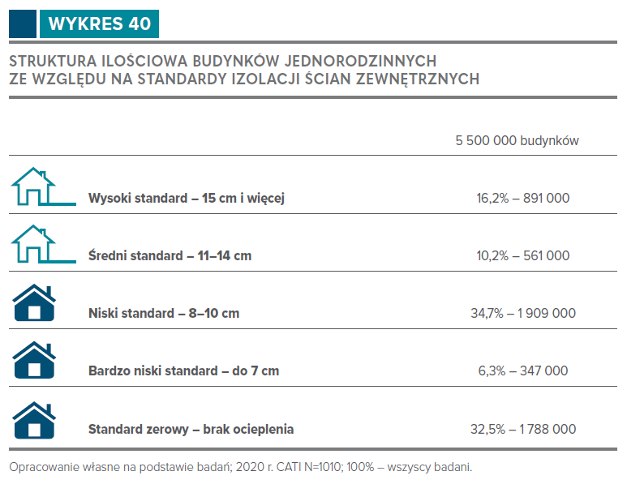
Apart from the heating source, the thermal insulation of the walls determines the energy efficiency of the building. The results of the research show that every third single-family building does not have any insulating layer of its external walls. Together with the buildings with only the thinnest insulation layers, this is a total of over 2 million houses. The lack of thermal insulation of walls is much more common in buildings located in rural areas. In cities, every fourth single-family building does not have insulation. Among insulated buildings, the largest group involves the buildings with an insulation layer in the range of 9-10 cm. 23% of the buildings are insulated with thermal insulation material with a thickness exceeding 10 cm. However, still a large number of the buildings are insulated with a layer not exceeding 8 cm. Together with the non-insulated buildings, their share significantly exceeds 40%. The trend of changes, however, is positive – the average thickness of the insulating layer among the insulated buildings is 11.6 cm. This is more than in 2014, when the value was 9 cm.
Knowledge of anti-smog resolutions
The anti-smog resolutions, which prohibit the use of substandard solid fuel boilers, are in force in almost all of Poland, except for: Opole, Podlasie and Warmian-Masurian voivodeships. The resolutions provide for a transitional period for adapting to these regulations. Depending on the voivodeship, these resolutions will be passed between 2021-2024 for below standard boilers, and for class 3 and 4 boilers in 2027-2028. After these dates, only eco-design (class 5 installations) or heating sources not based on solid fuels can be operated. As already mentioned above, the percentage of single-family houses that do not meet the requirements of anti-smog resolutions is as much as 54%, i.e. almost 3 million buildings.
The research shows, however, that only 45% inhabitants are aware of the fact that the resolution is in force in their voivodeship. In addition, the mere awareness of the fact that the resolution is in force is not tantamount to knowing about its specific provisions. Regarding the main provisions of the resolution, only 16% respondents were aware of the need to replace boilers other than the 5th class. 6% mention the ban on the use of low-quality coal, and 5% of respondents knew that the resolution in their voivodeship introduces a complete ban on the use of solid fuels. Others are either unaware of the resolutions or are not able to indicate what they refer to exactly.

The actual level of knowledge about the provisions of anti-smog resolutions can be shown by the level of knowledge of the date for the replacement of boilers provided in them. With regard to this, the research results leave no doubt that the level of knowledge of anti-smog resolutions is very low. Only 14% respondents from those voivodeships where the resolutions are in force are able to provide the correct date which is the final date for the replacement of boilers (the correct answers also include dates earlier than the final date specified in the resolution). These results clearly inform the authorities of all levels – central, regional and local, that efforts should be significantly intensified in the field of informing citizens about the provisions regarding the ban on the use of boilers that do not meet the requirements of anti-smog resolutions.
Knowledge of support programs
One in four owners of a single-family building included in the research has not heard about the availability of support programs for the replacement of heating sources and other thermomodernisation investments. Almost half of the respondents indicate that they know that such programs are available, but do not know their names and, as a rule, do not know the details. The government "Clean Air" program is the most frequently mentioned of all the support programs. At the same time, according to the surveyed awareness of the respondents, the availability of grant funding relief for thermomodernisation is very low – unprompted, it is indicated by just 0.8% respondents.

What about coal?


Methodology
The research was carried out by the CEM Market and Public Opinion Research Institute in November 2020. The CATI telephone interview technique was used, based on a standardised interview questionnaire. The research was carried out on a random sample of 1010 owners of single-family houses throughout Poland. The sample selection was controlled according to the structure and the location of buildings in rural or urban areas. Only persons who had influence in the household on investment decisions related to the technical condition of the building participated in the research. The realised sample with the number of 1010 interviews, with the assumed level of 95% confidence, results in an estimation error in the range of +/- 3%.
Author: Anna Dworakowska, Polski Alarm Smogowy
1Poland’s Informative Inventory Report 2020. Submission under the UNECE CLRTAP and NEC Directive. Air pollutant emissions in Poland 1990–2018, Ministerstwo Klimatu, Warszawa 2019
2Domy jednorodzinne w Polsce. Źródła grzewcze, stan energetyczny, priorytety inwestycyjne, Instytut Ekonomii Środowiska, Polski Alarm Smogowy, Kraków 2021
3Efektywność energetyczna w Polsce. Przegląd 2013, Instytut Ekonomii Środowiska, Kraków 2014